1. Grade Level and Subject: 9-12 mixed; Latin 1
2. Instructional Objectives:
A. Students will be able to explore images, both ancient and modern, in terms of symbolism, and what possible messages that symbolism can convey.
B. Students will be able to explore images, both ancient and modern, in terms of narrative and what possible message that narrative in images can convey.
3. Rationale:
The goal of this mini-unit is to explore both ancient images and modern images. There are two foci; both involving images as a mean to convey a message. The first focus is to explore images as symbols. The second focus is to examine images for narrative purpose.
As a secondary, but not necessarily less important goal, is to explore how images can convey agendas, especially in advertising or propaganda. While the images viewed in class will be both ancient and modern, there is a component of media literacy in the mini-unit. Propaganda is in no way new; the goal is to draw a line between the ancient and modern. The hope is that using the vocabulary of media literacy will enable to the student to better interpret ancient images, and provide a way to approach modern images with some acumen.
4. Vermont Framework of Standards:
5.14 Responding to Media: Students interpret and evaluate a variety of media, including audio, graphic images, film, television, video, and on-line resources.
5. Knowledge, Skills, and Attitudes promoted:
A. A healthy skepticism of images purposefully presented by ancient and modern media.
B. The ability to discuss with some level of coherence the possible meanings and purposes that an image can convey.
6. Sequence of Activities:
The mini-unit consists of three lessons over three days. The expectation is that each lesson will take between 50 minutes to an hour. All lessons assume the use of a computer projector. Also, all Powerpoints will be posted on the class' Edline page, and thus available for students outside of class.
Lesson 1
- Start with this: http://www.sporcle.com/games/sportlogos.php
- Then this: http://www.sporcle.com/games/corplogos.php or maybe even http://www.sporcle.com/games/digdirb/fast_food_logos, depending on the class.
- Then a Powerpoint is opened, showing a close up of an aegis, like this:

- Then, the full picture is drawn back to show a statue of Athena and the question of how we can identify the statue as being that of Athena. A slide with the definitions of symbol and attribute is present; back to Athena: what are her attributes? What do they symbolize?
- Next slide is of a police man. How do we know who this is? Same question for pictures of a scientist, a Nascar driver, a guy in a suit.
- This last slide transitions from attributes and symbols used to establish specific identity to attributes that can be general. Maybe that guy in a suit is the President of France?
- The rest of the Powerpoint consists of a mix of slide of the Olympian gods and other generic figures.
- Students will be given a handout with a blank entry for each slide. The expectation is that they indicate attributes, identity (if known), or a guess about who is shown in the slide. Also, students are asked to indicate if any attributes are acting symbolically.
- Students will be given a handout with a blank entry for each slide. The expectation is that they indicate attributes, identity (if known), or a guess about who is shown in the slide. Also, students are asked to indicate if any attributes are acting symbolically.
Lesson 2
- This lesson is mostly groundwork for lesson 3.
- As a class, we’ll read the Herakles chapter, pgs. 135-144 from Classical Mythology & More. (Colakis and Masello, Bolchazy-Carducci Publisers, 2007.)
- A Powerpoint focused on images of the Hercules Farnese. Students will start considering the statue by indicating attributes and symbols. This slideshow will introduce the Seven Principles of Media Education, accompanied by the ACME handout.

- Each Principle will be introduced individually, returning each time to the statue to explore the statue for that particular principle. For Principles that are terribly difficult to discuss using the statue, I’ll provide another example, such as http://www.youtube.com/watch?v=CTY8hrvFck8 to discuss pacing and production techniques.
Lesson 3
Today the focus is to examine images that have narrative content using the Seven Principles.
- A PowerPoint starts with a picture of a bust of the Roman emperor Commodus, done up like Hercules, and students are asked for a little interpretation.
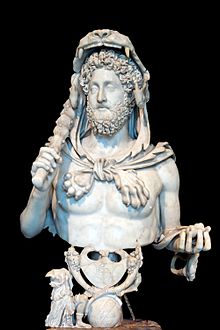
- I’ll reveal that the bust is actually Commodus, and ask how an emperor casting himself as Hercules relates to the Seven Principles.
- We then progress to images of the metopes from the Temple of Zeus at Olympia.
- Students are asked to identify the figures in the sculptures by their attributes, and then ask to tell the story presented by the images.
- Students are then shown another statue of Hercules simply being a static Hercules, side by side with an image of Hercules completing one of his labors, and are asked to describe the difference between image as simply representational and images that tell a story.
- I'll give general background on Temple of Zeus at Olympia, showing more of the metopes, plan of the temple, and general description of the sanctuary, and the stories behind the pediment friezes.
- Students are then asked to describe the narrative sculptures using the terminology of the Seven Principles.
7. Criteria for Evaluation:
Oh, right now I’m thinking that the assessment will be another PowerPoint with several images that demonstrate either symbols or narrative, or more likely both, and ask students to identify the figures, symbols, and stories. Students will then be asked to identify as many of the Seven Principles in each image as they can.
8. Expectations of Student Response:
Students who are only familiar with Hercules from the Disney movie will be shocked that Herakles killed his first wife and kids. It always happens, and usually sets up a dialogue about how I am not overly fond of Disney.
That aside, I expect/hope the students to be engaged. In addition to this being about media literacy, I’m hoping the connection between ancient and modern will somehow plant the seed of the idea that no matter how far apart in time, people are more or less just people. The best outcome of this mini-unit would be students who are willing to look at images a bit more critically, and to be able to express what they see, and why they are skeptical about the experience.

Hi James,
ReplyDeleteI really like the media/iconographic connections between ancient and modern images here, using the seven principles - I think you could become the most media-literate Latin instructor on the planet.
No hyperbole.
Thanks for diving deep here.
Veni. Vidi. Vici.
Unit W