Monday, August 1, 2011

Final Project

1.  Grade Level and Subject: 9-12 mixed; Latin 1

2.  Instructional Objectives:
A.  Students will be able to explore images, both ancient and modern, in terms of symbolism, and what possible messages that symbolism can convey.
B.  Students will be able to explore images, both ancient and modern, in terms of narrative and what possible message that narrative in images can convey.


3.  Rationale:
The goal of this mini-unit is to explore both ancient images and modern images.  There are two foci; both involving images as a mean to convey a message.  The first focus is to explore images as symbols.  The second focus is to examine images for narrative purpose.
As a secondary, but not necessarily less important goal, is to explore how images can convey agendas, especially in advertising or propaganda.  While the images viewed in class will be both ancient and modern, there is a component of media literacy in the mini-unit.  Propaganda is in no way new; the goal is to draw a line between the ancient and modern.  The hope is that using the vocabulary of media literacy will enable to the student to better interpret ancient images, and provide a way to approach modern images with some acumen.

4.  Vermont Framework of Standards:
5.14 Responding to Media: Students interpret and evaluate a variety of media, including audio, graphic images, film, television, video, and on-line resources.


5.  Knowledge, Skills, and Attitudes promoted:
A.  A healthy skepticism of images purposefully presented by ancient and modern media.
B.  The ability to discuss with some level of coherence the possible meanings and purposes that an image can convey. 


6.  Sequence of Activities:

The mini-unit consists of three lessons over three days.  The expectation is that each lesson will take between 50 minutes to an hour.  All lessons assume the use of a computer projector.  Also, all Powerpoints will be posted on the class' Edline page, and thus available for students outside of class.


Lesson 1

-          Start with this: http://www.sporcle.com/games/sportlogos.php
-          Then this: http://www.sporcle.com/games/corplogos.php or maybe even http://www.sporcle.com/games/digdirb/fast_food_logos, depending on the class.
-          Then a Powerpoint is opened, showing a close up of an aegis, like this:


-          Then, the full picture is drawn back to show a statue of Athena and the question of how we can identify the statue as being that of Athena.  A slide with the definitions of symbol and attribute is present; back to Athena: what are her attributes?  What do they symbolize?
-          Next slide is of a police man.  How do we know who this is? Same question for pictures of a scientist, a Nascar driver, a guy in a suit.
-          This last slide transitions from attributes and symbols used to establish specific identity to attributes that can be general.  Maybe that guy in a suit is the President of France?
-          The rest of the Powerpoint consists of a mix of slide of the Olympian gods and other generic figures.
-     Students will be given a handout with a blank entry for each slide.  The expectation is that they indicate attributes, identity (if known), or a guess about who is shown in the slide.  Also, students are asked to indicate if any attributes are acting symbolically.


Lesson 2

-          This lesson is mostly groundwork for lesson 3.
-          As a class, we’ll read the Herakles chapter, pgs. 135-144 from Classical Mythology & More.  (Colakis and Masello, Bolchazy-Carducci Publisers, 2007.)
-          A Powerpoint focused on images of the Hercules Farnese.  Students will start considering the statue by indicating attributes and symbols.  This slideshow will introduce the Seven Principles of Media Education, accompanied by the ACME handout.

-          Each Principle will be introduced individually, returning each time to the statue to explore the statue for that particular principle.  For Principles that are terribly difficult to discuss using the statue, I’ll provide another example, such as http://www.youtube.com/watch?v=CTY8hrvFck8 to discuss pacing and production techniques.


Lesson 3

Today the focus is to examine images that have narrative content using the Seven Principles.

-          A PowerPoint starts with a picture of a bust of the Roman emperor Commodus, done up like Hercules, and students are asked for a little interpretation.
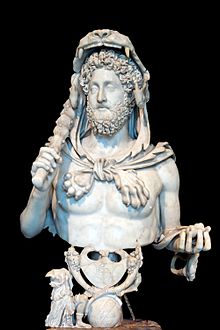


-          I’ll reveal that the bust is actually Commodus, and ask how an emperor casting himself as Hercules relates to the Seven Principles.
-          We then progress to images of the metopes from the Temple of Zeus at Olympia. 
-          Students are asked to identify the figures in the sculptures by their attributes, and then ask to tell the story presented by the images.
-          Students are then shown another statue of Hercules simply being a static Hercules, side by side with an image of Hercules completing one of his labors, and are asked to describe the difference between image as simply representational and images that tell a story.
-          I'll give general background on Temple of Zeus at Olympia, showing more of the metopes, plan of the temple, and general description of the sanctuary, and the stories behind the pediment friezes.
-          Students are then asked to describe the narrative sculptures using the terminology of the Seven Principles.  

7.  Criteria for Evaluation:
Oh, right now I’m thinking that the assessment will be another PowerPoint with several images that demonstrate either symbols or narrative, or more likely both, and ask students to identify the figures, symbols, and stories.  Students will then be asked to identify as many of the Seven Principles in each image as they can.

8.  Expectations of Student Response:
Students who are only familiar with Hercules from the Disney movie will be shocked that Herakles killed his first wife and kids.  It always happens, and usually sets up a dialogue about how I am not overly fond of Disney.
That aside, I expect/hope the students to be engaged.  In addition to this being about media literacy, I’m hoping the connection between ancient and modern will somehow plant the seed of the idea that no matter how far apart in time, people are more or less just people.  The best outcome of this mini-unit would be students who are willing to look at images a bit more critically, and to be able to express what they see, and why they are skeptical about the experience.


Thursday, July 28, 2011

Revelation 1

#1: It's probably necessary to give something up, or rather, it's probably necessary to choose what to get involved with, or not to get involved with.

Throughout the class, we've been introduced to all sorts of new technology, and shown ways to use that technology. Thinking about it, I've realized it's important to choose the things that will be useful personally, and professionally. Part of this, of course, is to recognize what I don't have a use for at all.

Revelation 2

#2: Music, Image, and Emotion in the Limbic Cortex

Again, something I knew, but didn't think about it beyond just knowing it. In hindsight, it makes complete sense. Why can music and images convey such powerful ideas? Because they're wired into the same place that is the home to emotion. Good lyrics in the song? The neocortex gets involved. It's pretty much wonderful.


And - pretty much terrifying the way that a jingle can get worked into the brain and never leave:

Revelation 3

#3: The Seven Principles, and Language in general

I think about language all the time. I like to know the origins of idioms, words, and cultural references. Language and how we interact with it changes our brains, and how we cognitively interact with our reality.

The 7 Principles gives me coherent way to discuss media literacy, and that's important to me; language, more or less, is what I do, both professionally and to a large extent personally. I believe that language truly is power.


"Pay no attention the man behind the curtain."

Revelation 4

#4: The News isn't News, and the Five Filters

I've listened to Amy Goodman's Democracy Now, before, and I've realized that TV news is pretty much not newsworthy, but it was nice of her to point out exactly how much the news isn't reporting news. Both nice, and saddening.

If it's pretty much universally agreed that we need a steady diet of news to have a proper democracy, the lack of real information and breadth in the media puts our democracy, in general, in a terrible place. How are people supposed to make informed choices about who runs the government and what that government does with the information? And, if internet media is only feeding us the news stories that it thinks we'll click on, rather something truly informative and perhaps outside our normal proclivities, how are we ever supposed to expand our thoughts beyond our own preferences?

For example, this is not really news:


So why was this produced solely on the internet? Who owns this? What is it selling?

Revelation 5

#5: I really had ads, and I love Vermont for not having billboards.

Since I've begun thinking about advertisements, I've really started to notice how inane they are. I think the first I noticed this was back when my Father questioned this:


And asked, "Now more than ever, what?"

Now I understand that the open ended nature is completely purposeful, allowing the audience to create their own reality around whatever they think they're seeing.

So why is Vitamin Water a Revolution? Am I really supposed to believe that your drink is better because you've replaced the high fructose corn syrup with crystalline fructose? And that it will revive me, make me pretty, help my bones, or cure my cold? I think I'd be better off eating broccoli.

Also, Coca-Cola owns Vitamin Water.

Wednesday, July 27, 2011

Revelation 6

#6: Google is Skynet.

Here's some scary stuff: Google wants 100% of your data. And, while they're at it, they'd like to show you what they believe you're looking for using a complicated algorithm.

Or maybe not:


Ceding control of what we're seeing to a set of mathematical operations seems unwise. While we can control this to some degree using available filters, what if I want to see something unfiltered? What if I'm looking for something completely different from my own opinions, thoughts, beliefs, etc?

Also, they'd like to build an Artificial Intelligence. This makes me nervous, as I've read far too much science fiction to think that this is a good idea. Well, except for Isaac Asimov's Three Laws of Robotics.

Revelation 7


#7: RSS

Before RSS, I had a bookmark folder that contained bookmarks to all the online comics I read. I used to open it up, go get some coffee, and when I came back, everything had loaded, including all those pages that hadn't been updated. Now with RSS, my wait time simply doesn't exist. Thank you, internet.


Revelation 8


#8: Proof the internet can make you "dumb," or "If it's not in your brain you don't know it."

Carr wrote a whole book about how the internet can make a brain shallow, and part of his argument is that by believing that knowing where information lives is as good as knowing that information. I've always had a problem with this since I first encounter it in an assessment textbook (of all places). Now, thanks to Carr, I have a few definite reason to back up my axiom.


Revelation 9


#9: "The Lizard Hot Spot"

Yes, I knew about the various large division in the brain, and I knew that advertisers seek to exploit the brain by accessing various parts of the brain, but seeing corporations in action in The Persuaders made it all the more real. The swank gathering in upstate New York with the intention of finding the code for "Luxury?" I'm pretty sure I've read that in a William Gibson novel.


Revelation 10


#10: Tools affect the brain.

I'm fascinated by tools and technology more than ever, and I mean tools in the largest possible sense. Whether it's a tool to shoot a nail at high speed into a chunk of wood or a new hard drive, I like tools.

Carr's discussion of how tools can affect the brain has lead me to think beyond his focus of reading and the internet. It was his mention of taxi cab drivers' brains that made me wonder what sorts of modifications happen from different careers. What parts of the brain are affected by teaching? What parts by being a carpenter? A circus clown? A non-euclidean geometer?


Monday, July 18, 2011

Interest in Media

I am interested in media as a omnipresent factor in the lives of my students. I teach Latin, but I've always been interested in aspects of technology and how technology influences how people think and gather information. Since media is now so intertwined in new forms of technology, my curiosity naturally runs into media. Also, I'd just like to be more conscious about media in general. Since it's so pervasive as to be nearly invisible, I'd like to be able to see the fnords.

Honestly, I'm not sure how I'm going to make these interests into a project. Yep.